Posts

Reading Notes: Babbitt. More Jataka Tales, Part B

Image
For this reading note, I am writing about  Beauty and Brownie  by Ellen C. Babbitt. This story was about two deers named Beauty and Brownie. The corn fields were getting ripe so it was season that was dangerous for deers to be around because hunters would leave out traps. Beauty and Brownie's father warned them of this and asked them to take their herds and to go to some high hills until the season was over. The father also advised them to travel only in the night so they would not be seen by the hunters. So Beauty and Brownie set off with their herds to the high hills. However, Brownie did not forgot what his father said and traveled in the daylight. He herded his herd straight into some hunters and lost some of his herd. Beauty remembered what his father had told him and did not lose one deer. When the season was ending, the two herds headed back to the forest. However, Brownie still did not learn his lesson. He traveled in broad daylight again and lost more of his herd. Bot...


Reading Notes: Babbitt. More Jataka Tales, Part A

Image
For this reading note, I am writing about  The Golden Goose  by Ellen C. Babbitt. This story intrigued me. It was about greed. There was a goose that had golden feathers. Not only was the golden goose beautiful, but kind. The goose saw that a family was struggling and decided to help them out. The family consisted of a mother and two daughters who were very poor. When the goose approached the family to help them out, the mother greeted him with suspicion. She did not know why the goose would help her and her family. The golden goose told the family that he would stop by every once in a while to give them a feather so that they could sell it. Because of this the family began to live comfortably. However, the mother's greed ruined them all. One day, she plotted to keep the golden goose and the house. She was afraid that the golden goose would not return one day and their source of income would disappear. She soon found out that if the feathers of the goose were forcibly taken ou...

Week 10 Lab:TEDEd Videos: Style

Image
For this week, I chose to do the story lab  TEDEd Videos: Style . The Power of Creative Constraints by Brandon Rodriguez caught my eye. When I think of the word "constraints" I think about limitations and barriers. However, this video saw creative constraints as a way to guide decision making. It allows for iterative and innovative thinking. What "Orwellian" Really Means by Noah Tavlin was interesting to me because I have not heard of the word "Orwellian" so I did not know what it "really" meant either so I learned something new. Orwellian is used to mean authoritarian. Orwell was a writer who wrote a book called "1984" which talked about a fictional totalitarian government. When "Orwellian" began to mean authoritarian the meaning of the word was not conveying it, but undermining it. It is in a sense an abuse to the language. I thought that it was an interesting thought. (Picture of 1984 for Orwell's Novel   Pixabay )...

Reading Notes: Babbitt. Jataka Tales, Part B

Image
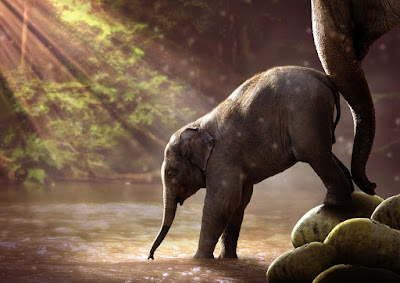
For this reading note, I am writing about  Granny's Blackie  by Ellen C. Babbitt. This story was a rich man who gave an elephant to a woman. This woman became known to be Granny and her elephant was known as Ganny's Blackie. Blackie would just eat, sleep, and play with the children. One day he wanted his Granny to go out to the woods with him, but she said she was busy with work. Therefore, Blackie decided to go out and find work to bring home some money for Granny. He found a job of moving wagons across the water. He was paid in silver for his work. When he came home, everyone was worried because he had not told anyone where he had gone. However, Granny was delighted when she found that Blackie went out and earned money for her. This was a really happy, feel-good story. If I were to retell this story I would make Blackie human because I saw many human characteristics in him. He was just a child which is why he just wanted to play, eat, and sleep. However, once he saw the resp...

Reading Notes: Babbitt. Jataka Tales, Part A

Image
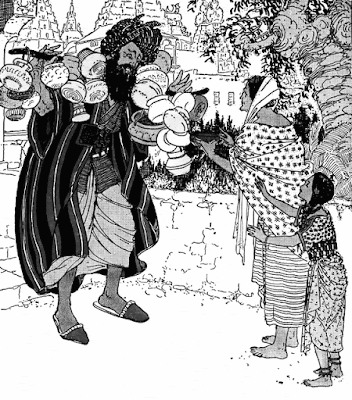
For this reading note, I am writing about  The Merchant of Seri  by Ellen C. Babbitt. This story was about a poor family consisting of a little girl and her grandmother. Their family was once rich, but they lost it all. From the past riches, the grandmother still had a golden bowl. However, she did not know the value. There were two merchants who would go into town to sell their goods. One of the merchants was greedy. When the grandmother and the little girl approached the greedy merchant, they offered the golden bowl to him for exchange for anything, the merchant caught on that they did not know the value of the bowl. The merchant threw the bowl to the ground and said it was worthless. He did this because he was planning on getting the golden bowl for dirt cheap. Then, he left. Another merchant came, but this one was kind. When the grandma attempted to trade her golden bowl again, this merchant was more receptive. He told them the value of this bowl and offered everything he ...

Week 9 Story: Oathkeeper

Image
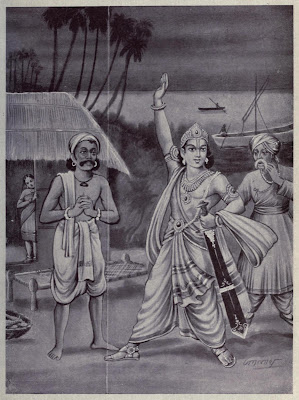
Long ago, King Shantanu met Ganga, the river goddess. From this matrimony he was able to procure one living son, Deverat. Deverat's other siblings had been drowned by his mother. Because King Shantanu spoke out against Ganga for her infanticide, Ganga took Deverat and left. Then, many years later King Shantanu was able to be reunited with his long lost son, Deverat. After many years of being alone, King Shantanu fell in love with Satyavati, a fisherman's daughter. However, she refused to marry him. "You already have a baby momma and her son will be the next king so why should I marry you?" said Satyavati "I.." King Shantu was speechless. What could he say? Even though he was a king, being a single father scared many women off. King Shantanu turned back to his kingdom deeply saddened. Deverat noticed his father's sadness and approached him. "What's wrong dad?" "Nothing, son. I am fine." However, Deverat knew this was not n...

Reading Notes: Mahabharata: Karmic Revolution, Part B

Image
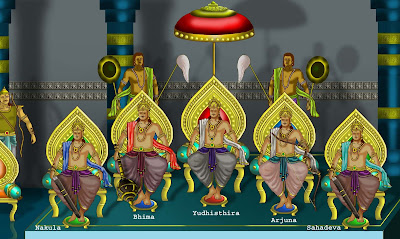
For this reading note I want to focus on the births of Pandu's and Dhirarashtra's sons. Pandu has two wives Kunti and Mardi. They all decided to dwell in the forest. However, because Pandu shot a hermit who was in the form of a deer, the hermit cast a curse on Pandu before he died. The hermit cursed Pandu that he would die when he would lay with a woman. It was fitting because Pandu shot the hermit when he was laying with another hermit who was also in the form of a deer. Kunti and Mardi had not had any children yet. Therefore, Pandu had no heirs to leave behind until Kunti revealed that she could called a god with a mantra and bear his children. One by one Kunti called the gods and had five children. Her first son, Yudhishthir, who was virtuous and patient was from Yama. The next son, Bheem, was strong and fast as the wind and he came from Vayudev, the Wind God. The last son from Kunti and Indra was Arjun. He was destined to be a great warrior. Madri did not have children ye...